EPU: The Exonian’s Club Of The Week – January 22nd, 2026
The article, which won The Exonian’s Life Section Article Pick, highlighted EPU’s impact at Exeter. Check out the article below!
Exeter Political Union: Politics Beyond Partisanship
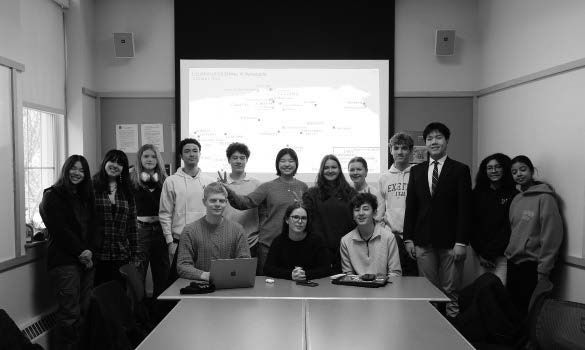
Sunday, 2 p.m. Throughout campus, the chimes of the bell reverberate, signalling different things for different students. Some snake their way downtown for a late lunch out. A few scuffle along the roads, with no particular destination in mind. For many, an afternoon nestled in their beds is the ideal way to savor the last of their weekend. But for a certain band of devoted students, it’s quite the opposite. The bell subsides and the ferocious pounding of a gavel is heard from the inside of EPAC219. Voices chatter and a Wikipedia image of an up-and-coming politician is projected onto the screen. The scents of fresh Dunkin’ tantalize passersby. As they peek through the curtain slits hanging on the main door, they catch the words Exeter Political Union scrawled on the whiteboards.
Exeter Political Union is an initiative revived by senior Dylan B. Richardson in the fall of 2024. Aiming to foster impartial political conversation for Exonians, it acts as a middle ground between the more ideologically-oriented Democratic and Republican clubs. Meetings begin with an in-depth presentation on modern political events, ranging from immigration policy to gubernatorial elections, and end in impassioned group debate. It is here, in EPAC219, where Richardson, along with coheads Victor Angeline and Lydia Kuhnert, orchestrates the space for complex and thought-provoking discussion.
For Richardson, politics has always been a fundamental interest in his life. As such, his proposition for EPU came quite naturally in the spring of his lower year. “My initial idea for the Exeter Political Union was to create a non-partisan discussion club on campus, and it was first branded as the Politically Independent Exonians,” he said. “For this club, I needed an advisor, and as I searched through the History Department page on the Exeter website, [an image of] one teacher caught my eye. Bill Jordan’s room was full of political memorabilia, and he apparently advised this club called the ‘Exeter Political Union.’”
Richardson was stumped. He had searched for EPU on the club list but was unable to locate it. “I figured it didn’t exist anymore,” he said. “When I contacted Mr. Jordan, he agreed to come on board, but only if we made our club a new iteration of the Political Union, rather than some entirely new project.” Richardson was happy to do so, and with Jordan’s supervision now secured, he then searched for a second cohead. “When I happened to run into Victor, who I had known previously, in the dining hall while he was wearing his U.S. Congress sweater, I asked if he wanted to join. He did. [So] we sent in the form, and EPU was born,” Richardson added.
Since EPU’s inaugural meeting last year, which only 10 to 15 students attended, the club has made impressive strides. “We have seen absolutely massive growth in this club since our founding. We wenvt from an entirely new project, to the largest political club on campus in only this year and a half, and it has been tremendously rewarding to see,” Richardson said. Today, EPU boasts a club roster of more than 70 students, has extended its leadership to include a third cohead in Kuhnert, and is committed to looking for ways to further connect members with the broader political landscape around them.
That commitment materialized most recently when on Jan. 11, EPU hosted candidate for U.S. Senate Karishma Manzur, who is running in the fast-approaching 2026 elections. Members noted a high turnout for the event and valued the insights she shared. As lower and attendee Larry Lyu said, “We really liked her talk in general. I think she had some good general points.… We really enjoyed the opportunity.” In the future, the EPU coheads look forward to continuing to carry out ambitious projects. “We plan to keep bringing in speakers, maybe some history professors or current elected officials, and to look for collaboration with Exeter’s other political clubs,” Richardson said.
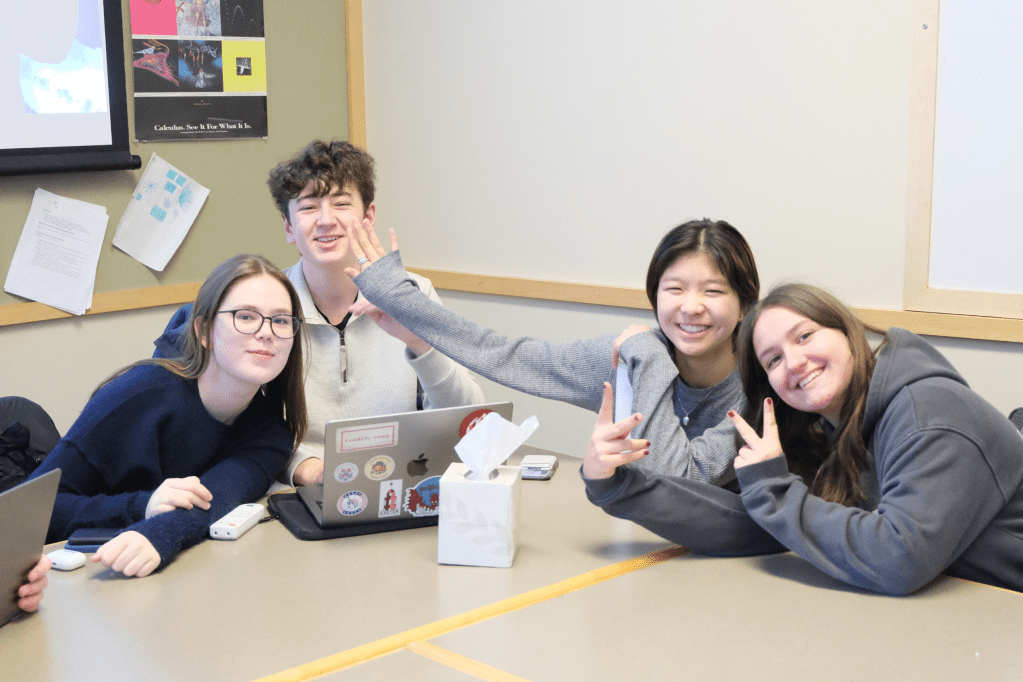
However, the extent of EPU’s impacts are not limited solely to its special events. For prep Izzy Cabral, devoted club member, EPU has allowed her to explore her own beliefs in greater depth by hearing the contributions of people engaging with and debating various opinions. “EPU taught me why I believe the things that I believe, and why those align [or don’t align] with [the opinions of] other members of the club,” Cabral stated. In an increasingly polarized political climate, this commitment to thoughtful, respectful disagreement remains the club’s defining principle.
Accordingly, the coheads are deliberate in steering their discussions away from neutrality. “As coheads we do moderate our meetings and choose topics, but we never moderate political stances or opinions,” Richardson explained. “EPU discussions are not about neutrality, and that’s the entire point. EPU discussions are about both hearing people who disagree with you, and listening to them,” he continued.
Kuhnert agreed with this analysis, underscoring the importance of EPU being a place for authentic student voices. “If you surround yourself with people who have the same opinion as you, you’re never going to challenge your beliefs,” she said. “So I think instead of trying to remain neutral on everything, which would make for pretty poor discussion… we’re trying to bridge both sides.”
This seemingly divisive aspect of EPU might make for an intimidating first impression, but it is far from the reality. For Kuhnert, the club’s greatest strength lies in the relationships forged through debate and compromise. “EPU has a really strong and tight-knit community,” she said. “I always come away from the club having learned something, [even if] I’m the one who made the slides,” Kuhnert added.
Richardson echoed this sentiment, noting that while advocating for one’s beliefs is central to EPU’s mission, the club’s culture has never strayed from the warmth and energy that have defined it since its founding. “People debate fiercely or energetically all the time,” he said, “but we generally manage to keep the atmosphere jovial.”
When asked to describe why he would encourage more students to join, Richardson replied, “Political awareness is absolutely central. Pericles said [that] ‘just because you don’t take an interest in politics, doesn’t mean politics will not take an interest in you.’” Richardson continued, “Even if you’re not consistently interested in politics, or don’t plan to study anything humanities-related in college, come for a meeting if the topic interests you, and just listen.”
In an age when Congress is as polarized and gridlocked as ever, and where the fear of speaking can hang over communities nationwide, EPU offers Exonians a forum to express their opinions passionately, authentically, and without fear. Whether you aspire to pursue a path in politics, or simply want to learn more about current political issues, it is safe to say that the door to EPAC 219 — and the people who sustain the space — will welcome you with open arms.
Political Clubs to Host Forum Discussing Free Speech
-By The Exonian Staff Report
Exeter’s Republican Club, Exeter Political Union, Democratic Club and Daniel Webster Debate Society, will be hosting a forum to consider this very question tonight in the Academy Center forum.EPU co-head and senior Michael Shao will moderate the forum, which will feature a panel of teachers, including history instructor Michael Golay, science instructors Michael McLaughlin and Townley Chisholm and English instructor Mercedes Carbonell. For the first half hour of the forum, Shao will direct preliminary questions at the panelists. Following that, audience members and panelists will engage in an open discussion surrounding free inquiry and speech on campus.The event was conceived to address concerns about open discussion on campus, many of which were brought to light when a politics seminar presented by Fred Grandy ’66, was cancelled.
“This is a true academic environment and in order for it to be a true academic environment, we need to be able to have open discussion.”
“No doubt closing our doors to Grandy played an important role [in the conception of the forum],” McLaughlin said. “That decision is still one of the largest elephants in the room. The time is absolutely ripe for these conversations.”Republican Club co-head and senior Lily Friedberg agreed that the seminar’s cancellation, which was due to “a concern that [Grandy] had associations with people and ideas which were offensive and with which most of us at this institution disagree,” unearthed questions about freedom of speech on campus, and about “the way we culturally treat people who disagree with the liberal majority.”However, she hopes that the panelists will view the Grandy situation as one case. “We want this to be a conversation about issues and ideas more than about past events. There is more to be brought to light than just this,” Friedberg said.Peter Luff, a co-head of the Republican Club, explained that the forum will revolve less around specific topics, such as whether or not Fred Grandy should come to campus, and more around pertinent and relevant themes. He said he hopes the campus can engage in respectful and inclusive discussions surrounding these issues.Friedberg explained that Republican Club has been trying to have this discussion for a while, and that the recent stirrings on campus and on platforms such as Exeter Confesses have provided an optimal window.“Now that we’re in the spotlight, we really want to have this conversation,” she said. She noted that on the other side of the conversation, she hopes to address “how we have conversations about difficult topics, like Islamophobia, in a way that’s open to all viewpoints without contributing to the problem.”Students on campus recently have felt this concern about the suppression of free speech on campus, particularly of conservative voices.Luff said that although he has had some fantastic teachers who encouraged political debate and open discussion, “the faculty usually restrict free speech because they find it a safer option.”He said, “It is disturbing that Exonians nowadays only feel safe expressing their views in an anonymous online forum like Exeter Confesses. Some other seniors and I wanted to give students and faculty a venue where they could share their views on these important topics freely and in person.”Senior Matias Valenta felt that this panel can serve as an awakening for students. “Freedom of debate and reason has been sacrificed for an almost fascistic implementation of comfort and communitarian complacency,” he said.Valenta mentioned that certain words, if invoked in a discussion, bring the discussion to a halt, thereby impairing reasoning. “As soon as one speaks the words “offensive,” “uncomfortable” or “triggered,” all debate ends there, no reason has to be given, no proof or dialogue has to be had. It is thought and speech control,” he said.Friedberg also explained the importance of addressing an issue of “sensitivity” in discussions.“There’s a fuzzy area between being politically incorrect and being disrespectful to people, especially minorities, in this country. It is about diversity of opinion, but it is also about the diversity that we frequently discuss on campus,” Friedberg said.Friedberg described the necessity of students exiting their comfort zones to pursue important conversations.“Safe spaces are important and we should strive to make people feel safe in general, but not all places can be safe places,” she said. “This is a true academic environment and in order for it to be a true academic environment, we need to be able to have open discussion. I hope [the forum] can be a way of starting this discussion and being able to have it in a way that is respectful as possible.”Golay said he hopes to see a good turnout at the event.He said, “Academic institutions don’t work well when people feel tentative or constrained about expressing their ideas, whether in class or in club meetings or in the dining hall.”He highlighted the importance of hearing a wide range of voices. “It’s especially important that people feel free to express views that go against the grain. Free speech doesn’t mean much unless the protections apply to views we don’t like or disagree with,” Golay said.Golay hopes that the forum will be the first of many to address speech issues. He said, “The more gatherings of this kind, the better. The more we talk, the better we understand one another.”
Club of the Year: Exeter Political Union – June 9th, 2016
-The Exonian
As the United States moves towards electing its next president, Exeter Political Union (EPU) plays an increasingly important role in mobilizing students to take political action. By sparking discussion on campus, inviting speakers, giving students the resources to be politically active and encouraging eligible students to vote, EPU has provided the Exeter community with political opportunities spanning the partisan spectrum.
This year, EPU hosted a mock primary election on the same day as the New Hampshire primary to see how Exeter students would vote if given the opportunity. The mock primary was well received by the Exeter community, publicizing the political process and provided insight into students’ political leanings.
“It was really interesting to look at the results, and I think it helped to encourage student political involvement,” senior and EPU co-head Sean Taylor said.
EPU also hosted many speakers this year with the assistance of the history department. Lawrence Lessig, a professor at Harvard Law School who had sought the Democratic nomination, gave a talk at an assembly prior to the New Hampshire primary. Lessig encouraged students to take action to reform a corrupt political system. A C-SPAN radio host, Alex Heffner, also spoke at an assembly. In his talk, he discussed the populist nature of the 2016 election.
“I’m sure that the connections we’ve established this year with various campaigns will come in handy at perhaps even bringing one of the nominees to campus.”
In addition, EPU invited two history professors from the University of New Hampshire to campus, Dante Scala and Andy Smith. They not only gave a talk at Assembly, but also took part in an event open to the public concerning the history and statistics behind the New Hampshire Primary.
With many candidates establishing offices and hosting events in New Hampshire earlier this year, EPU aided students with getting involved in the political process.
The club’s heads contacted many campaigns and developed relationships with political staggers in the area, creating internship opportunities for students and scoring invites to campaign events.
The EPU also informed students of public events being hosted by candidates in Exeter and encouraged students to attend. Candidates such as Rand Paul, Carly Fiorina, Marco Rubio, Ted Cruz, Bernie Sanders, Donald Trump and John Kasich all held rallies in Exeter attended by members of the club.
“I wanted students to know when these events were happening, encouraging them to go see candidates they wouldn’t normally agree with. I always say it’s good to be open-minded and listen to people from every angle—you might find yourself surprised,” Taylor said.
Senior Michael Shao, another co-head of EPU, expressed the importance of EPU’s presence on campus during the New Hampshire primary. “We harnessed and captured the spirit of discussion and involvement this year.” he said.
Shao further pressed the importance of students engaging with politicians from multiple viewpoints and stressed the role that EPU has played in encouraging dialogue. “I think that we have provided a serious privilege to engage students in bipartisan, active discussion with speakers and events from both sides of the isle, to help students determine for themselves what they think matters and what they think they believe in, instead of pushing a partisan agenda,” he said.
Shao said that EPU fought against the sentiment that Exeter keeps students in a political bubble. “Many students complain that Exeter does not help students become politically active. Through our lobbying, we helped and indirectly pushed Exonians to engage themselves politically,” he said.
In the future, the Exeter Political Union plans to revive the Exeter Political Review, an annual publication of political pieces. In doing so, the club hopes to further the political discussion that they have already fostered on campus through various forums and events. Shao hopes that the Review will “provide a platform for bipartisan political pieces in a peer-reviewed publication.”
The co-heads hope that the leadership next year will continue to engage in the political process and encourage students to vote in the presidential election. “We’ll continue to be involved with the federal elections for president as well as congress,” upper Bonnie LaBonté, a co-head of EPU, said.
Shao emphasized how the work done this year could lead to even more opportunities next year for the EPU. “I’m sure that the connections we’ve established this year with various campaigns will come in handy at perhaps even bringing one of the nominees to campus,” Shao said.
Club adviser and history instructor Bill Jordan shared his hopes for what EPU will accomplish in the coming year. “I hope the co-heads will continue to keep track of the candidates, spread the word if they’re coming to Exeter and get faculty to drive to rallies,” he said.
He further expressed his hope that the EPU will continue to foster political discussions on campus.
“As the election draws to a close, I’d love to see them focus more on issues and get speakers who are academics or involved in some kind of activism or political policy,” he said.

